Introduction: A city that stops in time
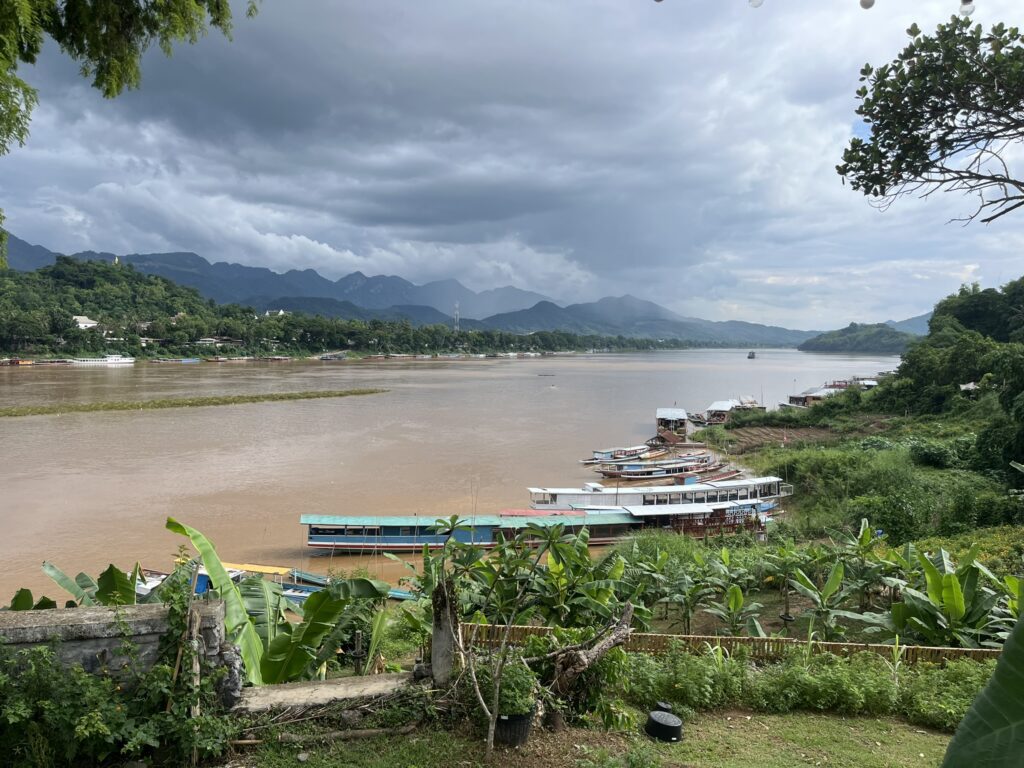
There are places in the world where you arrive and immediately feel that time moves differently. Luang Prabang is one of them. Nestled at the confluence of the Mekong and Nam Khan rivers in northern Laos, this small, luminous city carries the weight of a thousand years of history in its golden temple spires, its saffron-robed monks, and its quiet, tree-lined streets. It is a place that has been called the best-preserved city in Southeast Asia — and once you step foot here, it’s easy to understand why.
Founded in 1353 as the capital of the Kingdom of Lan Xang — the Kingdom of a Million Elephants — it was named after the Phra Bang, a sacred golden Buddha statue believed to protect the land and legitimize its kings. For centuries it thrived as a center of Theravada Buddhism, royal power, and Lao art and culture. The French colonized Laos in 1893 and used Luang Prabang as their northern administrative seat, layering elegant colonial villas alongside ancient temples in a fusion that survives to this day.
When France withdrew and Laos gained independence in 1953, the city remained the royal capital — home to a living monarchy, its golden wats intact, its monks moving through the streets each morning in unbroken centuries-old ritual.
Then the war came. From 1964 to 1973, the United States secretly dropped more than two million tons of bombs on Laos — making it, per capita, the most heavily bombed country in history — as part of a covert campaign to cut the Ho Chi Minh Trail and stop the spread of communism through Southeast Asia.
Luang Prabang itself escaped the bombs, but the war devastated the countryside and fueled the rise of the Pathet Lao, the communist movement backed by North Vietnam. In 1975, they seized power. The monarchy was abolished, King Savang Vatthana was sent to a remote re-education camp where he later died, temples were shuttered, and Luang Prabang went silent.
It remained largely closed to the outside world for over a decade. When UNESCO designated it a World Heritage Site in 1995 — praising it as the best-preserved city in Southeast Asia — the world finally took notice of what the isolation had, paradoxically, protected.
Why tourists come: Highlights you cannot miss
Tak Bat: The Alms Giving Ceremony
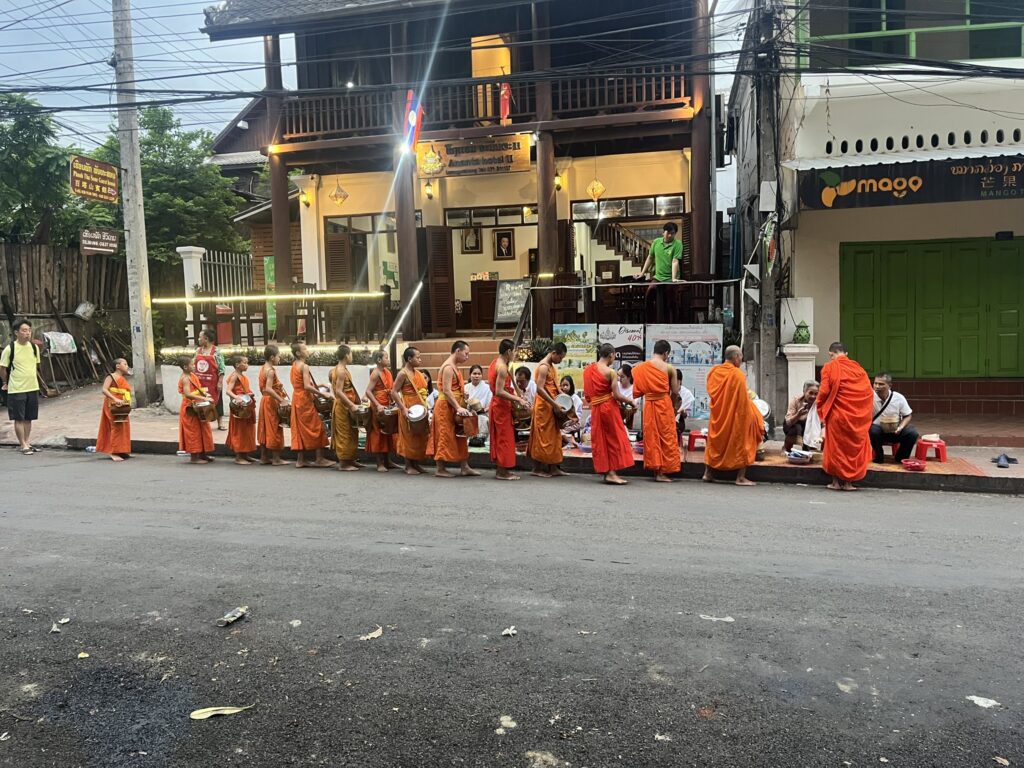
If there is a single image that defines Luang Prabang in the imagination of the world, it is the Tak Bat: the early-morning procession of monks collecting alms.
Every morning, before sunrise, hundreds of saffron-robed monks — from the heads of the oldest monasteries to the youngest novices, some barely teenagers — file silently through the streets in long, winding lines. Devout locals and visitors kneel along the curbs, offering sticky rice and fruit from woven baskets. The monks receive, bless, and move on. The whole procession is conducted in near silence, a kind of meditation in motion.
This practice is not a performance for tourists. It is a living tradition, unbroken for centuries, connecting the people of Luang Prabang to their spiritual ancestors in an unbroken chain of devotion. Tak Bat happens every single morning, whether there are observers or not. It is, perhaps, the most eloquent expression of what this city is: a place where the sacred is not preserved in traditions in the open air.
Insider Tip: To avoid the crowds that surround Sisavangvong Road, instead hit a side street like Kitsalat Road at around 5:30 AM for a more intimate experience
Wat Xien Thong: Laung Prabang’s most famous Wat
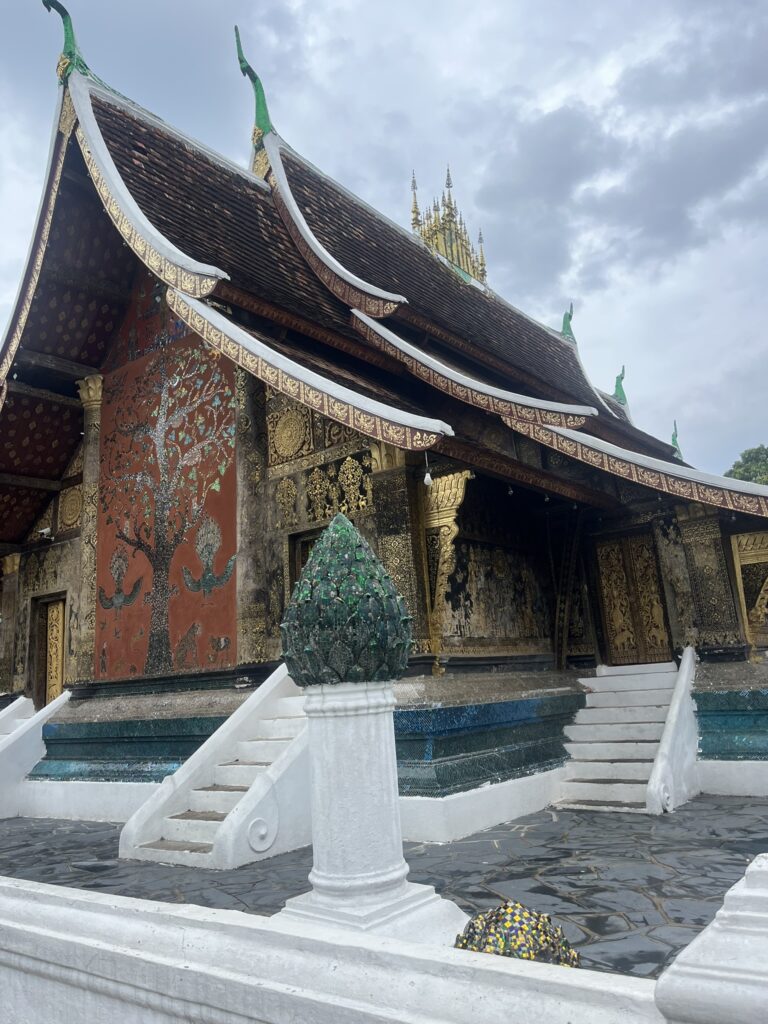
Built in 1560 during the reign of King Setthathirath, Wat Xien Thong is considered the finest example of Luang Prabang temple architecture.
Its roof sweeps almost to the ground in multiple tiers, and its rear façade is covered in a stunning mosaic depicting the Tree of Life — an impressive array of colors that symbolizes creation, harmony, spiritual life, and the balance of spiritual and material life.
Wat Xieng Thong survived every sacking, every war, every revolution. It stands today as it has stood for nearly 500 years: as proof that beauty, if it is sufficiently extraordinary, has a way of surviving the worst that imperial history can offer.
Entrance fees cost around 30,000 kip ($2) and is about a 20-minute walk from the morning market (LP is extremely walkable, tuk-tuks not needed).
Kuang Si Waterfalls
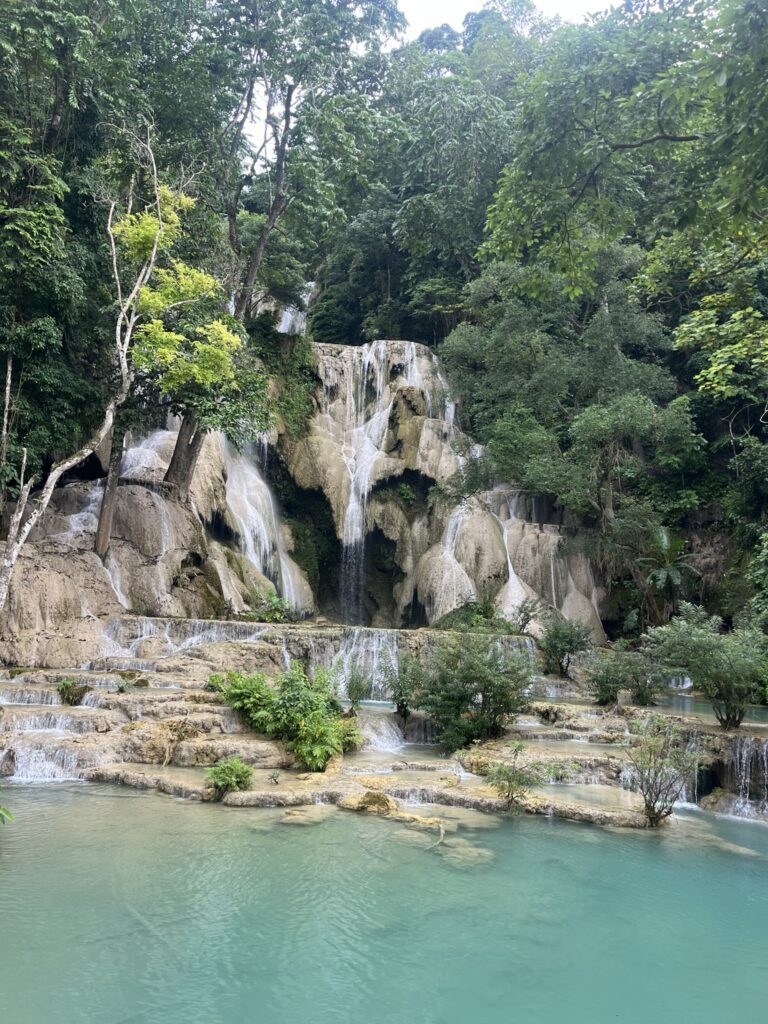
Thirty kilometers south of the city, the Kuang Si waterfalls cascade down a series of turquoise tiered pools beneath a canopy of jungle.
The water cascading from the limestone — runs an otherworldly shade of aquamarine. At certain times of day, the light through the trees turns the whole scene into something that feels like a painting rather than a physical place. Pack a swimsuit, the pools are open for swimming and are extremely refreshing.
The surrounding mountains are home to traditional Hmong and Khmu villages, communities whose cultures predate the Lao kingdom and who continue to weave, farm, and observe their own ceremonies alongside the Buddhist lowland culture of the city.
Tickets cost around $3 USD and include a trolly ride to the base of the waterfall. Restaurants are prevalent at the base of the waterfall and provide cheap eats before or after your journey.
Insider tip: Kaung Si Waterfall boasts the Tat Kuang Si Bear Rescue Center, an enriched environment for the ever-adorable Asiatic Black Bear, and its included in the waterfall entry fee!
Garavek
Tucked down a quiet lane just 200 meters from Wat Xieng Thong, Garavek is one of Luang Prabang’s most quietly unmissable experiences. Founded in 2012, the tiny 30-seat theatre was created to preserve Lao myths, legends, and folktales — oral traditions that, unlike in neighboring countries, were never widely written down and have been passed on almost entirely by word of mouth.
Every evening from 6:30 to 7:30pm, a Lao storyteller performs in English, accompanied live by a musician playing the khene — a handmade bamboo mouth organ that is, by most accounts, the defining sound of Laos itself.
The tales cover the origins of local landmarks like Mount Phou Si and the Mekong River, and bring to life legendary figures like the kingdom’s founder Fa Ngum and the beloved folk trickster Xieng Mieng.
The name says it all: Garavek means “magical bird,” and for an hour in that candlelit room with the haunting drone of the khene(local instrument) filling the air, you’ll feel exactly that.
Tickets are around $5 USD at the door from 6pm. Go early — it sells out.

Mount Phou Si
Mount Phou Si is a Laung Prabang staple. Rising 328 feet above downtown Laung Prabang, this hilltop offers panoramic views of the skyline and the two rivers that in its conjunction, the Mekong and Nam Am.
The lore of Mount Phou Si makes this place quite unique, the legend of the Naga, a half human-half human deity in the Buddhist tradition called this place home.
While the steps may seem endless — the numerous wats alongside the 360° views of this majestic town make the effort worth it!
Admission is free but make sure to bring plenty of water and comfortable shoes.
UXO Museum
As a result of American bombing campaigns in the Vietnam war over neutral Laos, the country is the most bombed nation per capita in the World.
Many of these bombs went unexploded, which effects many innocent Laotian’s today.
The UXO Visitor’s Center provides an opportunity for tourists to learn more about the Secret War, providing survivor accounts, bombs on display, and a theater where educational films can be enjoyed about the crisis that Laos faces.
Entrance is free but donations are highly encouraged, the hours are Monday to Friday from 8am-5pm (closed from 11:30-1pm).
Wat Naviengkham village, On the road behind Souphanouvong Monument, Luang Prabang 0600 (12 minute walk from downtown).
Where to stay
Downtown Backpackers Hostel
This hostel was hard to beat for $3 a night in an absolutely fantastic location situated a few blocks from the Mekong and in the middle of the morning market.
This is one of the finds that get a budget traveler like me excited in a town with costs rising by the day.
The dorm was not luxurious but convenient and comfortable, offering features like a built-in locker attached to the bed for extra security. The bathrooms were clean and had hot water and the limited English-speaking staff managed to book a tour for me.
There is no included breakfast available or a bar like many hostels in the area, but honestly the tranquil vibe of Laung Prabang is a welcomed break from the party scene prevalent in Southeast Asia.
112 Thanon Souvanarath Ban Pakham, Luang Prabang 10003
How to get there
By plane: Laung Prabang does have an international airport servicing flights from Chiang Mai, Bangkok, Hanoi, and Siem Reap. Unlike the train station, the airport is located 6 minutes from the city center making it quite convenient for the busy traveller.
A one way ticket from Chiang Mai to Laung Prabang will run you around $155 (May 2026).
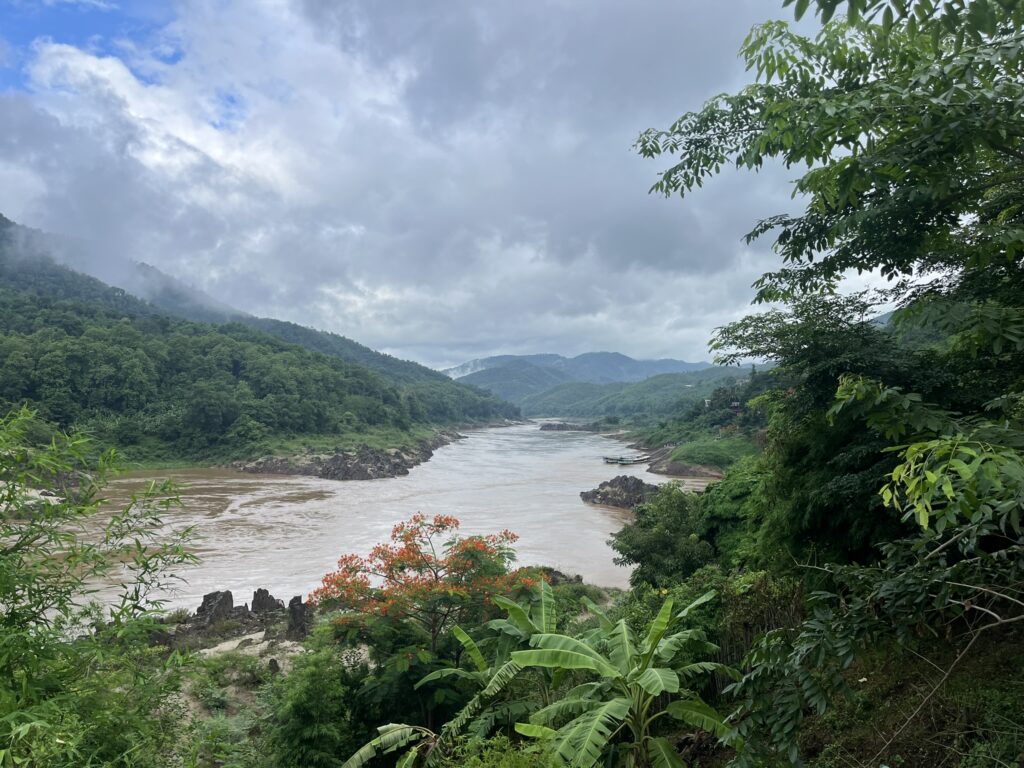
By Slow Boat: However, in the spirit of what the Authentic Adventurer strives for, the slow boat is 100% the right decision when travelling from Thailand to Laung Prabang.
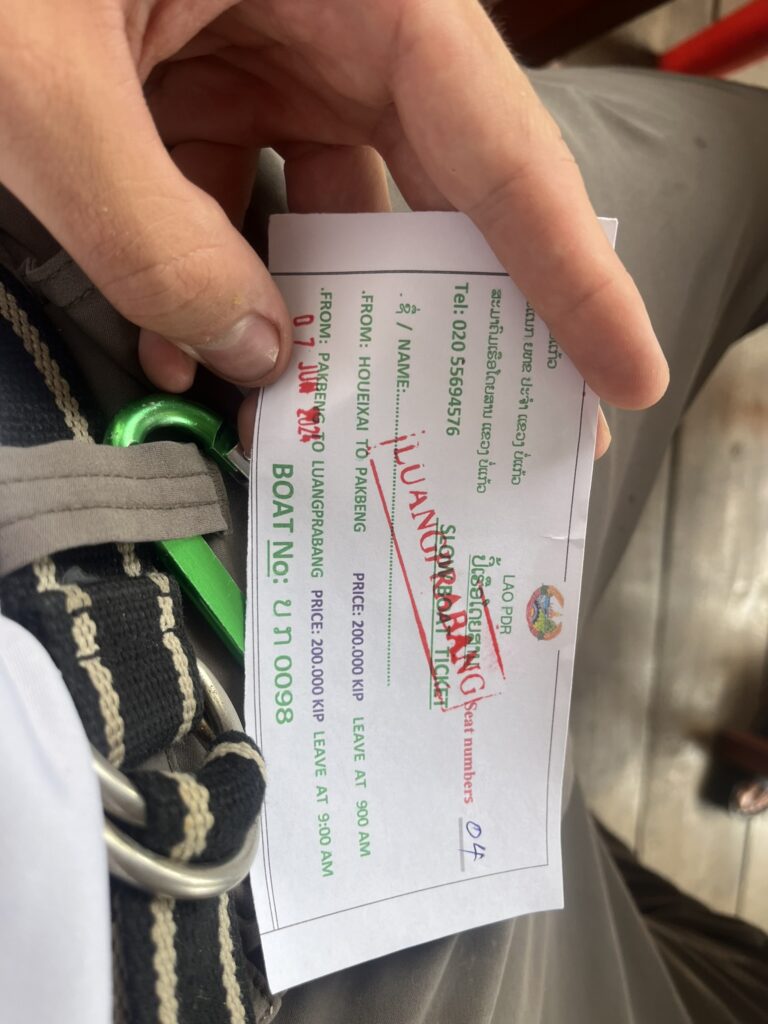
While the slow boat is not the most convenient or comfortable method of transportation, it remains one of the most beautiful and memorable experiences I had in all of my travels.
From Chiang Rai, you can take a transfer to the Lao border town of Huay Xai where the boat embarks from. The hotel I stayed in helped buy my slow boat ticket for about 400,000 LAK ($18), most hostels and hotels in Huay Xai will be able to book this for you and provide transport to the port.
Pak Beng, the halfway point of the boat journey is a village that is solely built for slow boat travelers to stay during their journey.
The second you disembark; you will find a myriad of locals offering you lodging for the night. I chose 99 backpackers, a typical dorm hostel with a killer view.
While I booked online and saved some stress, you will have no trouble finding adequate housing during your usual 1-night stop in this village.
By Train: China’s $6 billion dollar investment in Belt and Road railway connecting Kunming to Vientiane makes life a lot more convenient for locals and tourists alike.
The massive and modern station, easily a 30-minute tuk-tuk drive from downtown Laung Prabang is massive improvement compared to Lao’s brutal bus journeys.
I took the speed train from Laung Prabang to Vang Vieng and then to Vientiane after taking a grueling 3-hour van ride to Nong Khiaw and it was night and day.
It was clean, efficient, and relatively cheap with tickets around $20. The train itself is a technological feat, featuring 3 fast trains that run at 100 mph and 1 “slow” train that run at 70 mph for cheaper.(It really makes you wonder how much the U.S. lacks in public transport infrastructure.)
Tickets can be bought at ticket offices around towns with stations, but I recommend downloading the LCR official app for convenient purchasing.
Significance in the 21st Century
Today, Luang Prabang sits at a crossroads. Tourism has brought both prosperity and pressure. The city that was once too remote and too poor to develop rapidly now faces the challenges of its own success: rising prices, modernization from foreign investment and the risk that the rituals and traditions that draw visitors will be hollowed out by the very attention they attract.
As mentioned, the Laos-China Railway, opened in 2021 —now connects Luang Prabang to Vientiane and onward to Kunming in southern China, cutting a journey that once took days to a matter of hours.
This is transformative for Laos, a landlocked country that has historically struggled with geographic isolation. But it also means that the pace of change in Luang Prabang is about to accelerate dramatically.
The question that hangs over this small, beautiful city is the same one that hangs over every place that the world has decided to love: how do you preserve what makes a place extraordinary once the world arrives to find it?
Conclusion: A Place Worth Understanding
Luang Prabang is not simply a pretty destination, it is a testement of the extraordinary civilizations that have flourished in the heart of Southeast Asia. It is proof that Buddhism, given time and devotion, produces art of transcendent beauty.
It is evidence that colonial history, for all its evilness can leave behind architectural layers of genuine complexity. And it is a reminder that some things — morning light on a temple roof, the soft sound of monks chanting at dawn, the smell of frangipani in a temple courtyard — remain worth protecting and preserving.
Whatever comes next for this city, it has already earned its place in the story of human civilization. To visit Luang Prabang is not just to take a trip. It is to become, briefly, part of something very old, very beautiful, and very much alive.